
Your vegetable patch plan, and the jobs that go with it
Draw your beds and rows where they really are in the garden. Jardingo works out what needs doing, crop by crop: sowing, planting, weeding, feeding, watching for pests, harvesting, mulching.
Free, no adverts, no sign-up needed to start. On iPhone, iPad and in your browser; on Android soon.
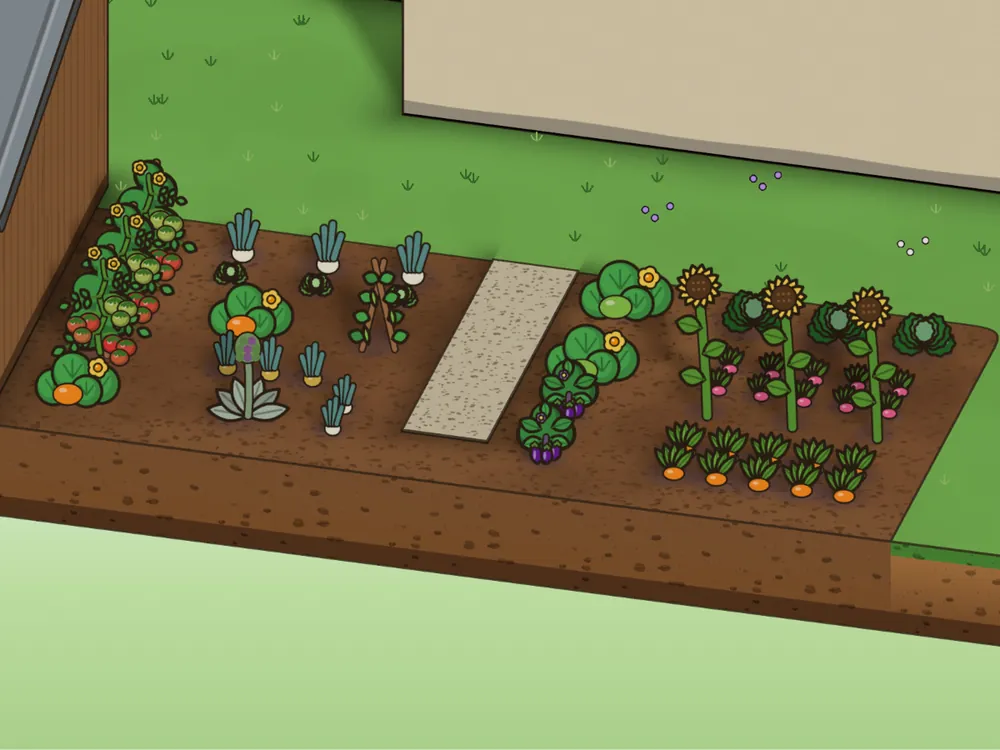
The vegetable patch, row by row
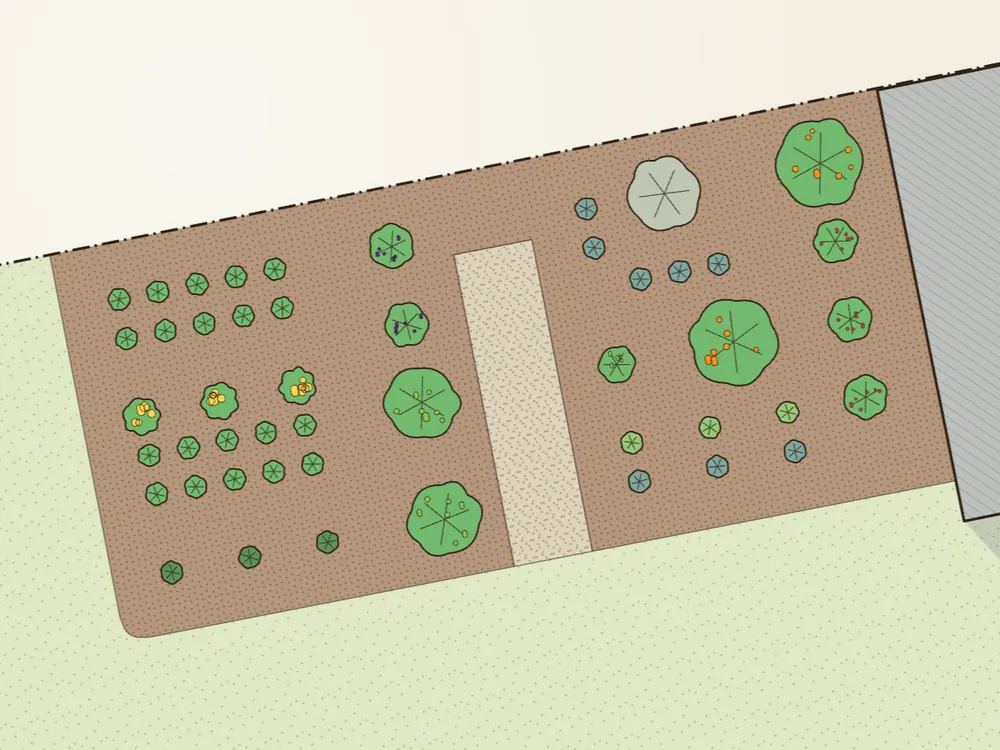
Paint the soil of the beds and paths of slabs or gravel, add a raised bed or a greenhouse, then place your vegetables: each one takes its spot at its spacing, a row of radishes next to a row of carrots.
- Seen from above, every vegetable has its own drawing and spread: the plan reads like a growing notebook.
- When you place a plant, its distances to its neighbours, the edges and the walls appear.
- Move the sun forward to see when the house or the shed shades the beds, and keep full sun for the tomatoes and squashes.
- A vegetable missing? Add it by name.
Vegetable jobs, worked out for you
Here are jobs Jardingo suggests through the year for a vegetable patch like this one. Each comes at the right time, with its “How to”.
-
Sow Tomato
Feb – Apr
Sowing from February to April.
How to do it
- Weed, remove stones and roots, then rake the surface to a fine tilth.
- If the soil is dry, water the bottom of the drill before sowing.
- Sow thinly, at a depth of two to three times the size of the seed (check the packet). Cover with fine soil and firm lightly.
- Water with a fine rose and keep moist until the seedlings come up.
-
Sow Carrot
Mar – Jul
Succession sowing: one row every 4 weeks, from March to July.
How to do it
- Weed, remove stones and roots, then rake the surface to a fine tilth.
- If the soil is dry, water the bottom of the drill before sowing.
- Sow thinly, at a depth of two to three times the size of the seed (check the packet). Cover with fine soil and firm lightly.
- Water with a fine rose and keep moist until the seedlings come up.
-
Plant Tomato
May
Planting out in May.
How to do it
- Water the plant well in its pot (or soak the root ball) before taking it out.
- Dig a hole two to three times wider than the root ball, but no deeper. Loosen the sides with a fork.
- Tease out roots that circle the pot. Set the plant at the same level as in its pot, unless its sheet says otherwise.
- Backfill, firm around the root ball without compacting it, and water generously.
-
Weed The whole vegetable patch
Apr – Sept
Hoe between the rows and pull weeds before they set seed: one hoeing is worth two waterings.
How to do it
- Hoe in dry weather: the cut weeds wither where they lie. In wet weather, gather them up or they will re-root.
- Run the hoe just below the surface, without going deep.
- Close to plants, pull weeds by hand. For perennial weeds (bindweed, couch grass), lift out every root with a fork, without breaking them.
- Weed before the weeds flower and set seed.
-
Feed Courgette
Jun – Sept
Hungry crop: potash-rich fertiliser or diluted comfrey tea, at the base, on moist soil.
How to do it
- On moist soil, spread around the base over the whole root area, keeping it off the leaves.
- Work it lightly into the surface with a hand cultivator, without digging.
- Stick to the stated dose: too much nitrogen gives soft growth that attracts aphids and diseases.
-
Watch for: Late blight Tomato
Jun – Sept
Brown patches spreading across leaves and stems, hard fruit marbled with brown; follows a few warm, wet days.
Natural remedy: Keep tomatoes out of the rain and never wet the leaves; remove and bin (not compost) affected parts; grow resistant varieties.
How to do it
- Check the undersides of leaves, young shoots and flower buds often.
- Act at the first signs: squash or pick off by hand, cut out affected parts.
- Pick up fallen diseased leaves and fruit; take them to the recycling centre.
- Encourage natural predators (ladybirds, hoverflies, birds) and tolerate a few pests. Treat only as a last resort, and only the affected plants.
-
Harvest Red kuri squash
Sept – Oct
Harvest from September to October: pick whatever is ripe.
How to do it
- Pick in dry weather and put the crop in the shade straight away. The cool of the morning suits most vegetables; strawberries and melons taste better picked in the warmth.
- Cut the stalk with secateurs or a knife, or snap it between your fingers, rather than pulling on the plant; a sweetcorn cob comes away with a sharp twist. Leave at least 10 cm of stalk on squashes for storing.
- Pick regularly: many crops (beans, courgettes, cucumbers…) then produce more.
- Handle without bruising; store only what is sound.
-
Mulch Globe artichoke
Nov
Before the frosts (hardy to −10 °C): 5 to 10 cm of straw, dead leaves or wood chips at the base.
How to do it
- Weed, then mulch onto moist, unfrozen soil; water first if it is dry.
- Spread 5 to 8 cm of mulch (straw, fallen leaves, wood chips, compost) around the base.
- Leave a few centimetres clear around the stem or trunk to prevent rot.
- Do not mulch Mediterranean plants (thyme, lavender) with material that holds moisture.
Months for a temperate climate (lowland France): the planner shifts them for your garden’s climate, based on the last ten winters. Watering is worked out every day from the rain that fell and evaporation.
Questions
Which vegetables are included?
Common vegetables, herbs and soft fruit, each with its own drawing, spacing and calendar, and a detailed guide for many of them.
Do the dates take my area into account?
Yes: sowing, planting and harvesting months are shifted for your garden’s hardiness, based on the last ten winters.
What about succession sowing?
For lettuces, radishes, carrots or beans, the planner suggests a new row at regular intervals throughout the sowing season: every 2 weeks for radishes, every 4 for carrots.
What about watering?
Jardingo follows the rain that fell and evaporation where you are, and tells you when to water, young plants included. It also warns you before frost and heatwaves.